


Key Takeaways:
- Stop Cup Leaks: Identify common reasons for menstrual cup leaks, such as incorrect fit, improper placement, and clogged rim holes, and learn how to troubleshoot these issues effectively.
- The Real Cost of Period Care: Understand the importance of choosing the right cup size and firmness based on your individual anatomy, flow, and lifestyle to prevent leaks.
- Why Menstrual Cups Leak: Menstrual cup leaks are typically caused by an incomplete seal, clogged rim holes, incorrect size or firmness, or the cup being positioned incorrectly relative to your cervix.
- Leak Troubleshooting: Gain practical tips for managing leaks during exercise and overnight, ensuring confident and leak-free experiences with your menstrual cup.
A menstrual cup that leaks is more than just an inconvenience. It’s confusing, frustrating, and can leave you scrambling for extra protection just when you thought you had your period on lockdown.
If you’ve ever found yourself asking, “Why is my menstrual cup leaking?” you’re not alone. Even seasoned cup users encounter leaks from time to time, whether it’s from a tiny misstep when you insert the cup, a too-heavy flow, or changes in your body after pregnancy.
Before we go deeper, here's the short answer. Your menstrual cup is most likely leaking because of one of these seven reasons:
- Your cup hasn't fully opened or formed a seal inside your vagina
- The cup is positioned past (or above) your cervix instead of around it
- The rim holes are clogged with dried blood or debris
- The cup is the wrong size for your anatomy
- The firmness is wrong for your activity level or pelvic floor strength
- Your cervix is sitting inside the cup (hello, low cervix)
- The menstrual cup is full and overflowing on your heavy flow days
At Saalt, we believe that your period should empower you, not hold you back. That’s why we design premium, sustainable period care products, like our reusable menstrual cups and ultra-comfortable leakproof underwear. Because you’re meant to be supported through every stage of life.
And, in this guide, we'll walk you through each of the 7 causes — what's actually going on and exactly how to fix it.
Let's dive in and solve this leak together!
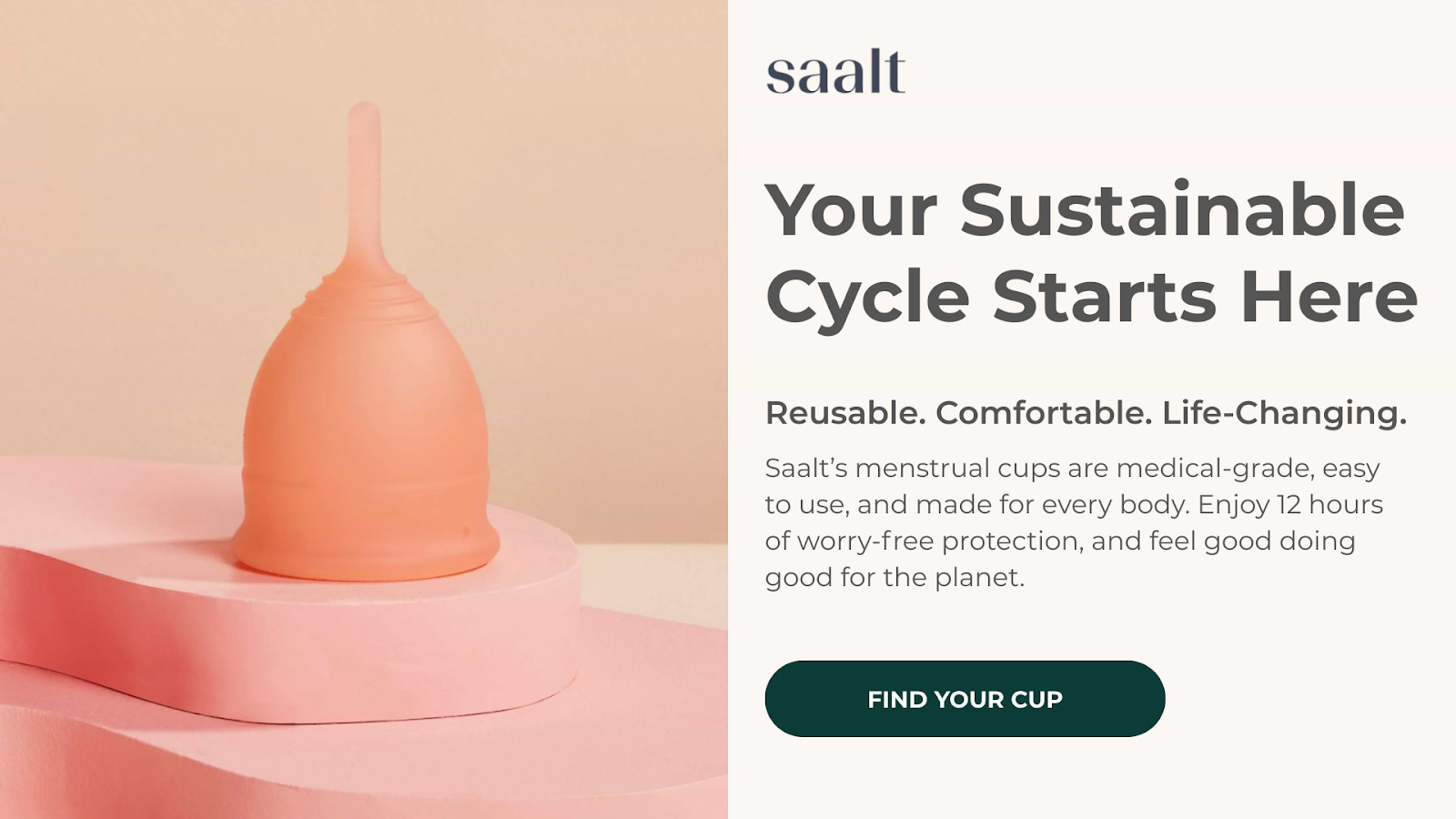
Why Is My Menstrual Cup Leaking When It Feels Inserted Correctly?
Few things are more confusing than a cup that feels perfectly in place but still betrays you. If you're asking "why is my menstrual cup leaking" when everything seems fine on insertion, the answer usually comes down to one of four things.
The good news is that all of them are fixable. Before we break each one down, here's a quick way to narrow it down:
|
Leaking Symptom |
Root Cause |
Immediate Fix |
|---|---|---|
|
Leaks immediately; cup stays empty |
Placed past or beside cervix |
Angle back toward tailbone; lower cup below cervix |
|
Leaks after 1–2 hours; cup half-full |
Cervix sitting inside cup displacing volume |
Switch to a shorter, wider low-cervix cup or menstrual disc |
|
Spotting right after inserting a sealed cup |
Residual blood in vaginal canal |
Wipe vaginal walls below the seal after insertion |
|
Leaks during workouts or bowel movements |
Pelvic floor muscle pressure squeezing soft cup |
Switch to a firmer cup that resists muscle compression |
1. The cup opened, but it's sitting above or past your cervix.
Your cervix should sit just inside the rim of the cup, not above it. If the cup floats past your cervix, blood bypasses the cup entirely and trickles out the sides.
The fix: Lower the cup so it sits below the cervix. After inserting, slide a clean finger up alongside the cup. You should feel the cervix dipping into the top of the cup, not sitting somewhere up and over it.
2. The rim holes are clogged.
Those tiny holes around the rim of the cup are what create suction. If they're blocked with dried blood or fibers, the cup can't form a seal, even if it looks open.
The fix: Remove the cup, fill it with warm water, cover the top with your palm, and squeeze so water shoots through the rim holes (more on this trick below).
3. The cup sits too low and the rim peeks below the vaginal opening.
If the base of the cup is too close to the entrance, the seal breaks the moment you move.
The fix: Push the cup a little higher (gently) so the rim sits comfortably inside, but never so high that it bumps the cervix.
4. Your cervix is sitting inside the cup.
If you have a low cervix, it can drop right down into the cup itself, taking up the space meant for your flow. That means the cup fills up much faster than expected — and overflows before you'd think.
The fix: Try a different cup with a shorter, wider shape designed for a low cervix, or consider switching to a menstrual disc, which sits higher up in the vaginal fornix.
Troubleshooting Leaks During Exercise
Exercising with your period shouldn’t mean worrying about leaks. If you’re asking, “Why does my period cup leak when I work out?”—you’re not alone. Here’s how to troubleshoot so you can stay active confidently.
1. Rethink the Fit: Physical activity engages your pelvic muscles, which can shift your cup or break the seal. If you’re experiencing leaks, your cup is too small, too firm, or not fully opening. Experiment with different sizes or firmness levels to find one that suits your body, especially if leaks happen mid-exercise.
2. Check the Seal: A strong seal prevents leaks. After inserting, run a finger around the cup or give it a gentle twist to make sure the cup has fully opened. Some people gently tug the cup down to help it settle and seal—essential during high-movement activities. (Mayo Clinic)
3. Perfect Placement: Placement matters. A cup that’s too high (like next to your cervix) can miss your flow; too low, and it may dislodge when you move. Make sure the cup sits just below your cervix. Try a couple of squats after inserting—if it stays comfortable, you’re set.
4. Be Flow-Smart: On heavy days, even a well-positioned cup fills faster during exercise. Empty your cup before working out for extra peace of mind.
5. Embrace Backups: If you still experience leaks, pair your cup with a thin liner or leakproof underwear like Saat’s Seamless Thong. It’s not a failure—it’s smart backup.
With these strategies, you can tackle your workout and your period—leak-free, comfortable, and confident every time.
Take Charge of Leaks With Saalt: Stay Dry, Confident, and CoveredStill asking yourself, “Why does my menstrual cup leak?” You’re not alone. At Saalt, we believe that leaks shouldn’t slow you down—whether you’re running errands, chasing after little ones, or simply enjoying your day. If troubleshooting your menstrual cup still leaves you a little worried, that’s exactly why we created Saalt’s leakproof period and bladder leak underwear. Here’s how Saalt keeps you comfortable and protected, no matter what life throws your way:
Ready to say goodbye to leaks, for good? Shop Saalt Leakproof Underwear today and join our mission to end period panic—forever. |
Finding Your Cervix Height and Position
One of the most overlooked reasons for menstrual cup leaks is actually the position and height of your cervix. The cervix is the small, donut-shaped opening between your vagina and uterus—it plays a big role in whether your cup fits like a glove or springs a surprise leak.
Figuring out your cervix height is a simple but powerful troubleshooting step. Here’s how to check:
1. Wash your hands thoroughly. 2. Find a comfortable position—standing with one leg up, sitting on the toilet, or squatting often works best. 3. Gently insert your index finger into your vagina.
- If you quickly feel a round, slightly firm bump (the cervix), you may have a low cervix.
- If you have to go nearly as far as your finger will reach, you likely have a high cervix.
- If your finger goes about halfway, you probably have a medium cervix height.
The position also matters. Some people have a cervix that sits off to one side rather than right in the center. If your cup always seems to leak, it could be because the cup isn’t sitting directly under the cervix, allowing fluid to sneak around the rim. Here’s a great video showing how to measure your cervix.
Tips for Trouble-Free Cup Placement:
- After inserting, run your finger around the cup’s rim to check it’s fully open.
- Wiggle or rotate the cup gently—it should settle snugly around your cervix.
- Aim the cup toward your tailbone, not straight up, following the natural angle of your vaginal canal.
- Always double-check the fit if you feel any discomfort or notice consistent leaks.
By understanding your own anatomy, you’ll be better equipped to choose the right cup and placement method, taking you one step closer to leak-free protection—no matter your flow or routine.

Identifying the Right Cup Size and Firmness
When you’re troubleshooting leaks and wondering, “Why does my menstrual cup leak?”, size and firmness are important—but often overlooked—factors.
Finding your perfect cup isn’t just about chance; it’s about matching your unique anatomy and flow to the right fit.
Size matters, and not always the way you think. A cup that’s too small may not open up fully and create a seal, while a cup that’s too large can feel uncomfortable or even fold, breaking the seal and leading to leaks.
Your ideal size isn’t always determined only by your age or whether you’ve given birth.
Consider your cervix height (check this by feeling for your cervix during your menstrual cycle with clean fingers), your flow (light, medium, or heavy), and the strength of your pelvic floor muscles.
For teens and those new to inserted menstrual products, Saalt does have a Teen Cup that works great as a starter cup. With a smaller size and softer silicone than the standard regular Saalt Cup, the Teen Cup can be a great place to begin for those new to inserted menstrual products as a “starter cup.”
Firmness makes a difference. Softer cups are great for those with sensitive bladders or who are new to cups; they’re comfy but might not pop open as easily, especially if your pelvic muscles are strong. Firmer cups are better at opening and sealing quickly—even for those who are active or have stronger muscles, but might press on your bladder, causing a bit of discomfort.
A quick checklist to help you assess:
- Low cervix or short vaginal canal? Try a shorter, smaller cup.
- Heavy flow? Go for a larger capacity cup.
- Sensitive bladder? Choose a softer cup.
- Postpartum? Choose a soft cup; the walls of your vaginal canal have been through a lot. They need gentle pressure for a season.
- Very active lifestyle or strong muscles? Firmer cups may prevent leaks.
Every body is different, and it might take some experimenting to get it just right. The key is to think of your cup like your favorite pair of jeans; when it fits right, you barely notice it, and you feel secure all day long.
Here's a quick at-a-glance comparison of Saalt's cup options to help you find the right fit:
|
Cup |
Best Flow |
Capacity |
Best For |
|---|---|---|---|
|
Saalt Regular |
Normal to heavy |
30 ml / 3–4 tampons |
High cervix, post-childbirth |
|
Saalt Small |
Light to normal |
25 ml / 2–3 tampons |
Low cervix, first-time users |
|
Saalt Teen |
Light to normal |
15 ml / 1–2 tampons |
Under 18 or petite physique |
Checking for Clogged Rim Holes
One of the most overlooked culprits behind a leaky menstrual cup? Those tiny holes around the rim of the cup. These small punctures might seem insignificant, but they play a big role in creating an effective seal.
If even one of those holes gets clogged, it can disrupt the gentle suction that keeps your cup in place—and that could be the answer to your question, “why does my menstrual cup leak?”
Here’s how to troubleshoot:
- Remove and Rinse: After removing your cup, hold it up to the light. Inspect each rim hole closely for any debris or blockage (menstrual blood can dry and block these spots). Give the cup a thorough rinse, focusing on running water directly through the holes.
- Skip the Toothpick or Pin Trick: Toothpicks, pins, and flossers are actually not recommended to clear your clogged rim holes. There’s a chance of creating tears in the silicone of your cup if you do this. Once the silicone of your cup is compromised, this can lead to further tearing, breakdown, and leaking of your cup – not to mention harboring bacteria. Just don’t do it.
- Flip it upside down: The best and easiest way to clear the rim holes of your cup is to:
- Holding your cup in one hand, fill your cup to the top with warm water
- Place your other hand over the cup
- Now turn your cup upside down or “flip it” with your hand that was covering the top, which is now on the bottom. Hold your cup firmly against your palm with the other hand, still keeping the water inside.
- Squeeze your cup, forcing the water through the holes.
- Wa- lah! Cleared holes!
Next time you find unexplained spotting or leaks, double-check those rim holes before making adjustments to your cup’s folding technique or position. Sometimes, the smallest details make all the difference.
Preventing Leaks Overnight
Waking up to a menstrual cup leak can be frustrating—but with a few simple tweaks, you can enjoy leak-free nights.
Check Cup Placement
If your cup isn’t sealed properly, it’s more likely to leak as you change positions while you sleep. After inserting your cup, gently rotate it or run a finger around the base of the cup [or rim] to ensure it’s fully open and sealed. Even a slight misalignment can break the seal and cause leaks. (Cleveland Clinic)
Choose the Right Size and Capacity
Heavier flows at night may overwhelm a small or low-capacity cup. If leaks are frequent, consider switching to a cup with a bigger size or higher capacity. Be sure the cup isn’t too large for comfort, as a poor fit can also lead to leaks.
Empty Before Bed
Start your night with an empty cup—even if it’s not full yet. This ensures you aren’t starting out with your cup at partial capacity, which reduces the risk of overflow before morning.
Add Backup Protection
Even well-fitted cups can occasionally leak, especially for those who move a lot in their sleep. To protect your sheets and gain peace of mind, consider wearing leakproof underwear or a backup liner overnight.
Track Your Flow
If you notice leaks are common on certain nights, note when your flow is heaviest. You might need to empty your cup a second time late in the evening during your heaviest days, or double up protection accordingly.
With the right size, secure placement, and a little planning, you can confidently sleep through the night, leak-free!
The Bottom Line: Confident, Leak-Free Living Starts Here
Leaking with a menstrual cup can be frustrating, but it doesn't mean you have to give up on all the comfort and confidence that comes with using one.
Whether your cup isn't fitting quite right, your removal technique needs a little refining, or your flow is heavier than expected, there’s always a solution. Understanding why does my menstrual cup leak is the first step toward finding what works best for your body and your routine.
Remember, a perfect seal, proper placement, and the right cup size make all the difference. Don't be afraid to experiment—or to reach out to our Saalt team, who’ve heard it all and are here to help.
And if your menstrual cup still isn’t doing the trick, Saalt’s leakproof underwear is a trusted backup or stand-alone solution. Our products, made without PFAs and designed for all stages of life, are made to keep up with you—whether you’re chasing toddlers, going for a run, or simply want to sleep in peace.
Periods and leaks shouldn’t slow you down. With Saalt’s premium, reusable solutions, you can say goodbye to bathroom sprints and last-minute wardrobe changes. You’ve got this—leak-free.
Read Also:
- Top Reasons Why Your Menstrual Cup Leaks
- Menstrual Cup & Disc Cleaning - Sanitizing vs Sterilizing
- How Hard Is Reusable Period Care Maintenance?
Frequently Asked Questions (FAQs)
Why does a menstrual cup leak even when it feels fully inserted and seated correctly?
Even when a cup feels perfectly seated, leaks can happen if the cup is positioned above or past your cervix rather than around it, if the rim holes are clogged, if the rim sits too low near the vaginal opening, or if your cervix is sitting inside the cup itself. The fix is usually a small adjustment. Try lowering or raising the cup so it cradles the cervix, clearing the rim holes, or testing a different cup shape designed for your cervix height.
Can the firmness or size of your menstrual cup cause it to leak during daily activity?
Yes. A softer cup may not pop open easily, especially if your pelvic floor is strong, so it never fully seals against the sides of the cup wall. A firmer cup pops open with confidence but can feel uncomfortable for sensitive bladders. Size plays a role too: if your cup is too small for your flow, it'll fill up before you expect it to; if it's too big, it may fold or shift during movement. Match firmness to your activity level and pelvic floor strength, and size to your flow and cervix height.
How do I know if my menstrual cup is the wrong size?
If you're getting consistent leaks despite proper insertion, or if you feel constant pressure or discomfort, your cup size might be the issue. A cup that's too small can shift around and fail to seal; a cup that's too big can feel uncomfortable or be hard to insert. Capacity matters too. If you're emptying every couple of hours on heavy days, use a menstrual cup that’s one size up. It can take a little trial and error to find your perfect fit, so don't get discouraged.
What are the most common reasons a menstrual cup leaks?
The most common reasons for menstrual cup leaks include improper insertion, the cup being the wrong size or shape for your body, an incomplete seal, or your cup overflowing due to heavy flow. Even tiny folds left in the cup or incorrect positioning (too high or too low) can cause leaks. Sometimes, leaks happen because the cup hasn’t fully unfolded once inside.
How do I know if my menstrual cup is the wrong size?
If you’re experiencing persistent leaks despite following proper insertion techniques, or if you feel consistent discomfort or pressure, your cup may be the wrong size. A cup that's too small may move around and fail to seal properly, while a cup that's too large could feel uncomfortable or be difficult to insert. It can take a little trial and error to find your perfect fit—don’t get discouraged!
Can a cup leak if it's not inserted properly?
Yes, absolutely—a poor insertion is one of the biggest culprits behind leaks. If your cup doesn’t fully open or if it sits at the wrong angle, menstrual fluid can sneak around the edges. Make sure you run your finger around the rim first, and then the base (not the stem!) after insertion to confirm the cup has fully opened and is in the right position. Little tricks like rotating the cup after it’s in place can also help ensure a leakproof fit. If you can feel your cervix after rotating your finger around the rim, you’ll need to lower and readjust your cup so that it sits below your cervix and not next to it.
What is the best way to ensure a good seal with my cup?
After inserting your cup, give it a gentle twist or wiggle to ensure it fully opens and creates a seal with your vaginal walls. You should feel or hear a slight “pop” as it unfolds. Running a clean finger around the base can help you feel whether the cup’s rim is smooth and open. Some people find that using a bit of water-based lubricant can help with both comfort and achieving a better seal.
What should I do if my cup overflows?
If your cup is overflowing, you may need to empty it more frequently, especially on your heavier days. Most cups can last 8–12 hours, but heavier flows may require empties every 4–6 hours. If you find yourself exceeding your cup’s capacity regularly, consider pairing your cup with Saalt Leakproof Underwear for extra peace of mind, or size up to a higher capacity model. Always listen to your body—and remember, leaks happen to the best of us sometimes!
Sources:
- Cleveland Clinic (2025, November 17) Everything You Need To Know About Menstrual Cups. https://health.clevelandclinic.org/menstrual-cup (accessed 28 November, 2025).
- Mayo Clinic. (2016, March 24) Menstrual Cups vs. Tampons: Things You Might Not Know. https://newsnetwork.mayoclinic.org/discussion/menstrual-cups-vs-tampons-things-you-might-not-know-about-the-cup/ (accessed 28 November, 2025).
Medical Disclaimer: The information provided in this article is for educational and informational purposes only and is not intended as medical advice, diagnosis, or treatment. Always seek the advice of a physician, gynecologist, or other qualified healthcare provider with any questions you may have regarding a medical condition, vaginal health, or the compatibility of reusable menstrual products with your body. Never disregard professional medical advice or delay seeking it because of something you have read on this website. If you think you may have a medical emergency, immediately contact a doctor or call your local emergency services.


